
Social Emotional Learning for 1st Graders: Skills and Simple Activities
By first grade, children are expected to do a lot more than sound out words and add numbers. They are also learning to name what they feel, calm themselves down, listen to a sibling or parent, and make a decent choice when something goes wrong. Social emotional learning for 1st graders covers all of that: the skills that help a 6- or 7-year-old understand themselves, get along with others, and handle the small problems that come up every day. This guide walks through what those skills look like at this age, plus activities you can try at home this week.
Social Emotional Learning for 1st Graders: What to Expect in Grade 1
At age 6-7, social-emotional growth is still very concrete. A 1st grader is learning to put a name to a feeling, not analyze why they feel it. They are learning to stop and think for a moment instead of reacting right away, and to tell the difference between listening and just waiting for their turn to talk. None of this happens in one sitting: it is built gradually, skill by skill, over the year, with plenty of repetition and real-life practice.
These skills usually fall into a few groups: understanding yourself, understanding others, making good choices, solving problems and staying safe, and growing as part of a family or community. Knowing the groups helps you spot which skill your child is working on at any given moment, whether that is during a lesson, at the dinner table, or in a disagreement with a sibling.
The Social Emotional Skills a 1st Grader Is Building
Understanding Myself
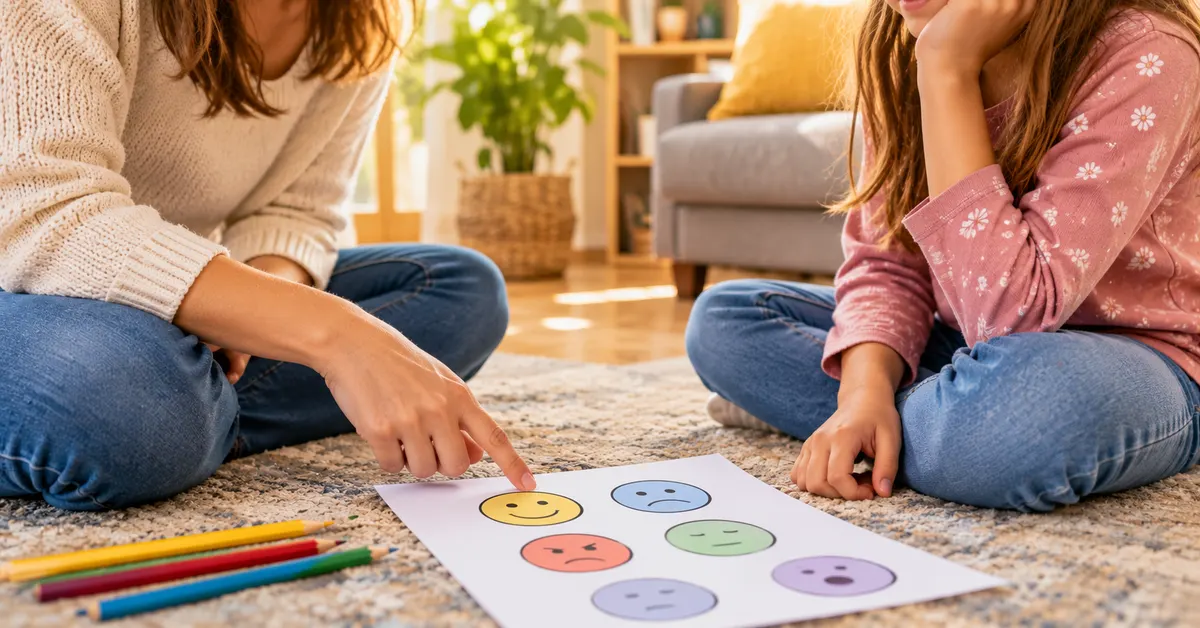
This starts with naming feelings, often by reading facial expressions: happy, sad, angry, scared, surprised, and a few more. From there, a 1st grader works on calming down once a big feeling shows up, using a simple, repeatable routine such as belly breathing and a few calming steps done in order.
Understanding Others
Respect and listening both belong here. A 1st grader is learning what respect actually means in everyday terms, and how to tell the difference between really listening to someone and just waiting to talk. Being a Good Listener is a good example of a skill that looks simple but takes real practice.
Making Good Choices
Thinking before acting means learning to stop for a moment before responding, instead of reacting on impulse. Being responsible follows naturally: matching an everyday situation (forgetting a chore, breaking something by accident) to the responsible way to handle it.
Problem Solving and Safety
A 1st grader is also learning simple steps for solving a problem calmly, rather than getting stuck or upset, along with early internet safety basics, like sorting online behaviors into safe and not safe.
Growing Together
This last group is about the bigger picture: celebrating success, their own and other people's, and noticing the everyday choices that help or harm the world around them, like caring for the earth.
Simple SEL Activities for 1st Grade at Home
You do not need a program to work on these skills. A handful of repeatable habits, practiced often, go a long way:
- Feelings check-in. At dinner or bedtime, ask your child to name one feeling from the day and what caused it.
- Calm-down practice. Practice belly breathing together when things are calm, so it is familiar when things are not.
- Listening game. Take turns being the talker and the listener, then ask what the listener remembers.
- Pause before reacting. Use a simple cue, like "stop and count to five," when frustration starts to build.
- One small job. Let your child choose a daily responsibility, like feeding a pet or setting the table, to build ownership.
- Problem-solving pause. During a sibling disagreement, ask, "What are two ways we could fix this?" instead of stepping in with the answer.
None of these need a formal lesson. Repeated often, with real attention, they build the habit over time.
Teaching Emotions at Home: How Parents Can Model It
Children this age learn emotional skills mostly by watching, not by being told. Naming your own feelings out loud ("I'm feeling frustrated, so I'm going to take a breath") shows that big feelings are normal and manageable. Apologizing when you get something wrong, thinking out loud before making a decision, and staying calm during a disagreement all teach more than any worksheet can. Teaching emotions at home works best when it is lived, not lectured.
How HSEA Teaches Social-Emotional Learning in Grade 1
HSEA's Grade 1 SEL curriculum is organized into five units that match the skills above: Understanding Myself, Understanding Others, Making Good Choices, Problem Solving & Safety, and Growing Together, 40 lessons in all. Like every HSEA lesson, each one includes a mini lesson with Words to know, guided practice, exercises on paper, and a Parent checklist you check off after correcting together.
At the table, the lesson is printed and ready before you start. You read it once while your child listens and tries the vocabulary, and the conversation that follows is the heart of the lesson. Your child works through the exercises on paper, you correct them together, and you check off what your child really understood on the Parent checklist. One focused lesson takes about 45 minutes at the table, plus a 10-minute screen review of the same lesson the next day. Start with one lesson a day the first week, then two a day at most, across all subjects.
Recognizing Feelings, the first lesson, is free to open on screen, so you can see a full SEL lesson for yourself. Lessons like How to Calm Down and Solving Problems Calmly build directly on the habits described above. You can browse the full Grade 1 SEL lessons to see how the units fit together.
If you are planning the rest of the year, the 1st grade reading at home and 1st grade writing at home guides cover the other core skills a 1st grader is working on alongside SEL.
Frequently asked questions
What are examples of social-emotional skills for 1st graders?
Naming feelings, calming down, listening well, understanding respect, thinking before acting, being responsible, solving problems calmly, and basic internet safety.
How can parents teach emotional regulation to a 6- or 7-year-old at home?
Practice a simple calming routine, like belly breathing, before big feelings show up, so it feels familiar in the moment. Naming feelings out loud and modeling calm reactions helps just as much.
Is social-emotional learning part of a homeschool curriculum?
Yes. Many homeschool curricula include SEL as its own subject. In HSEA's Grade 1 SEL curriculum, for example, there are 40 lessons organized into five units, each with a parent checklist the parent fills in after correcting together.
How long does an SEL lesson take?
In the HSEA SEL curriculum, one focused lesson takes about 45 minutes at the table, plus a 10-minute screen review of the same lesson the next day. Most families do no more than two lessons a day.