
1st Grade Writing at Home: A Step-by-Step Guide
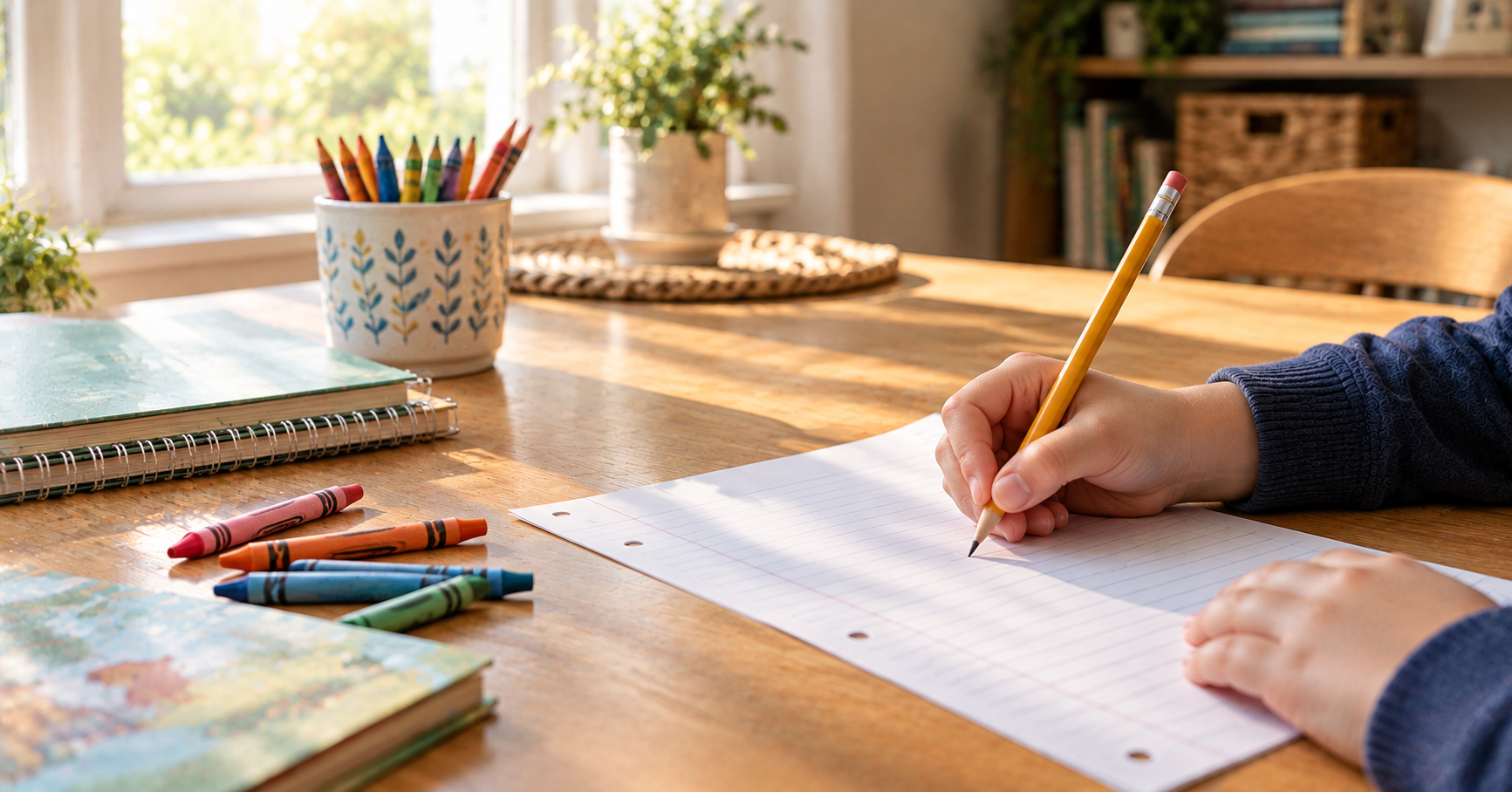
What 1st grade writing at home actually looks like
At six and seven, writing is not about essays yet. It is about holding a pencil comfortably, forming letters that other people can read, spelling short words by their sounds, and putting one complete thought on paper with a capital letter and a period. If your child can write something like "I like my dog." on their own by the end of the year, they are right on track.
Grade 1 writing usually moves through a few building blocks, in roughly this order: a correct pencil grip and clear letter formation, spelling simple words by breaking them into sounds, basic punctuation like periods, and then short pieces where the child puts a real idea into words — a favorite animal, a description of their room, a special day. Toward the end of the year, many children can also write a short thank-you note or a few lines in a diary.
How to teach writing to a 1st grader at home, step by step
You don't need a classroom to teach writing well. What a six- or seven-year-old actually needs is a parent's full attention for one focused lesson, repeated often, not a long session.
Start with the pencil and the letters
Before anything else, check the grip. A child who holds the pencil awkwardly will tire fast and avoid writing. Spend a few sessions just on holding the pencil with a tripod grip (thumb, index, and middle finger) and tracing letters slowly, out loud, saying the sound as they write it.
Move on to spelling short words by sound
Once letters are comfortable, the next step is spelling plain three-letter words — cat, dog, sun — by breaking them into their three sounds and writing each one down. This is where a lot of early spelling confidence is built. In HSEA's Grade 1 writing curriculum, this is covered directly in a lesson on spelling CVC words, which is a good example of the kind of practice to repeat at home even without any curriculum: say the word slowly, isolate each sound, write it, then read it back together.
Add punctuation and build toward full sentences
Once your child can spell short words, the next skill is knowing when a sentence needs a period and recognizing a complete thought. A lesson on periods and punctuation is a useful benchmark here: can your child tell the difference between "the dog ran" (needs a period) and a sentence that already has one? That one skill unlocks a lot of independent writing.
Move toward short, personal pieces of writing
With letters, spelling, and punctuation in place, children are ready to write short, personal pieces: naming something they like, describing it, and giving a reason using "because." A lesson on writing about a favorite animal is a good model for this kind of exercise — name it, describe it, say why you like it in one sentence.
1st grade writing activities to try this week
You can practice most of these skills with things you already have at home:
- Sentence of the day: ask your child to write one sentence about something that happened today, then check together that it starts with a capital letter and ends with a period.
- Sound it out: say a short word slowly (cat, hop, bed) and have your child write down each sound they hear before checking the spelling together.
- Describe your room: have your child write two or three sentences describing their bedroom or a favorite corner of the house, using at least one describing word.
- Letter to someone: write a short, real thank-you note or a note to a grandparent. It gives the writing a real purpose, which matters more at this age than any worksheet.
- Pencil warm-up: before writing practice, a minute or two of tracing shapes or letters helps a tired or wiggly hand settle down.
Pick one or two of these a day rather than trying all of them at once, and fit them into whatever daily homeschool schedule already works for your family. A single focused activity, done with your full attention, teaches more than a pile of worksheets done alone.
How to give feedback without discouraging your child
This is the part that worries most parents more than the writing itself. A few things make a real difference:
- Correct together, out loud. Instead of circling mistakes and handing the page back, sit with your child and point out what's off without giving the fixed answer right away. Let them try again — that second attempt is often where the real learning happens.
- Separate the idea from the mechanics. If your child wrote an honest, funny sentence with a spelling mistake in it, say what you liked about the idea first, then work on the spelling.
- Use a simple checklist, not a grade on everything. After correcting together, a short parent checklist — did they use a capital letter, a period, a complete idea — tells you and your child exactly what's solid and what still needs work, without turning every page into a test.
- End with something encouraging. A short, specific comment ("I love that you used 'because' to explain your reason") does more than a generic "good job," and it's something kids genuinely look forward to.
This is close to how I work through a lesson with my own kids: I read the lesson once while they listen, they try the vocabulary themselves, and the real learning happens in the conversation that follows, not in the worksheet alone. When they finish their exercises, we correct together, I explain mistakes without just giving away the answer, and I end with a mark and an encouraging comment. It takes about 45 minutes at the table, and the next day they do a short, roughly 10-minute review of the same lesson on screen, which helps the spelling and punctuation habits stick.
If you want a fuller sense of how a Grade 1 writing lesson is structured day to day, HSEA's Grade 1 writing lessons walk through this same progression — pencil grip, spelling, punctuation, and short personal writing — and the first lesson, Holding a Pencil Correctly, is free to try on screen.
A few things to keep in mind
Grade 1 writing develops unevenly — some children spell confidently before their letters look neat, others have the reverse. What matters most at this stage is consistency: a little focused writing practice most days, feedback that explains rather than just corrects, and real reasons to write (a note, a sentence about their day) rather than only worksheets. If you're also working on reading skills at home, the two subjects reinforce each other closely, since sounding out words for spelling uses the same skill as sounding out words for reading.
Frequently asked questions
What should a 1st grader be able to write by the end of the year?
By the end of Grade 1, most children can hold a pencil correctly, spell simple three-letter words by their sounds, write a complete sentence with a capital letter and a period, and put together a few sentences on a topic they know well, such as a favorite animal or a special day. Some can also write a short thank-you note or a few lines in a diary.
How often should a 1st grader practice writing at home?
Most children do well with one focused writing lesson a day. More than that tends to become overwhelming rather than helpful. A short daily habit, like one sentence about their day, builds skills steadily without burning your child out.
My 1st grader hates writing. What should I do?
Start smaller than you think you need to: shorter sentences, topics they actually care about, and a pencil grip check, since an uncomfortable grip alone can make writing feel like a chore. Praise the idea in what they wrote before fixing spelling or punctuation, and if the resistance seems tied to a physical or developmental concern, talk to your child's pediatrician or a specialist rather than pushing through it alone.
Should I correct every mistake in my child's writing?
Not every mistake at once. Pick one or two things to work on per piece of writing, explain the mistake without just giving the fixed answer, and let your child try again. Correcting everything at once usually discourages a young writer more than it teaches them.
Unlock the full HSEA system for 7 days.
Add your first kid profile and your 7 days start: every lesson in every grade, saved progress for each child. Nothing to set up, no card required, nothing to cancel.
- ✓ All 1,680 lessons, Grades 1–6, every subject
- ✓ Profiles + saved progress for every kid
- ✓ Printable lessons with answer key