
1st Grade Math Homeschool: What Your Child Learns and How to Teach It
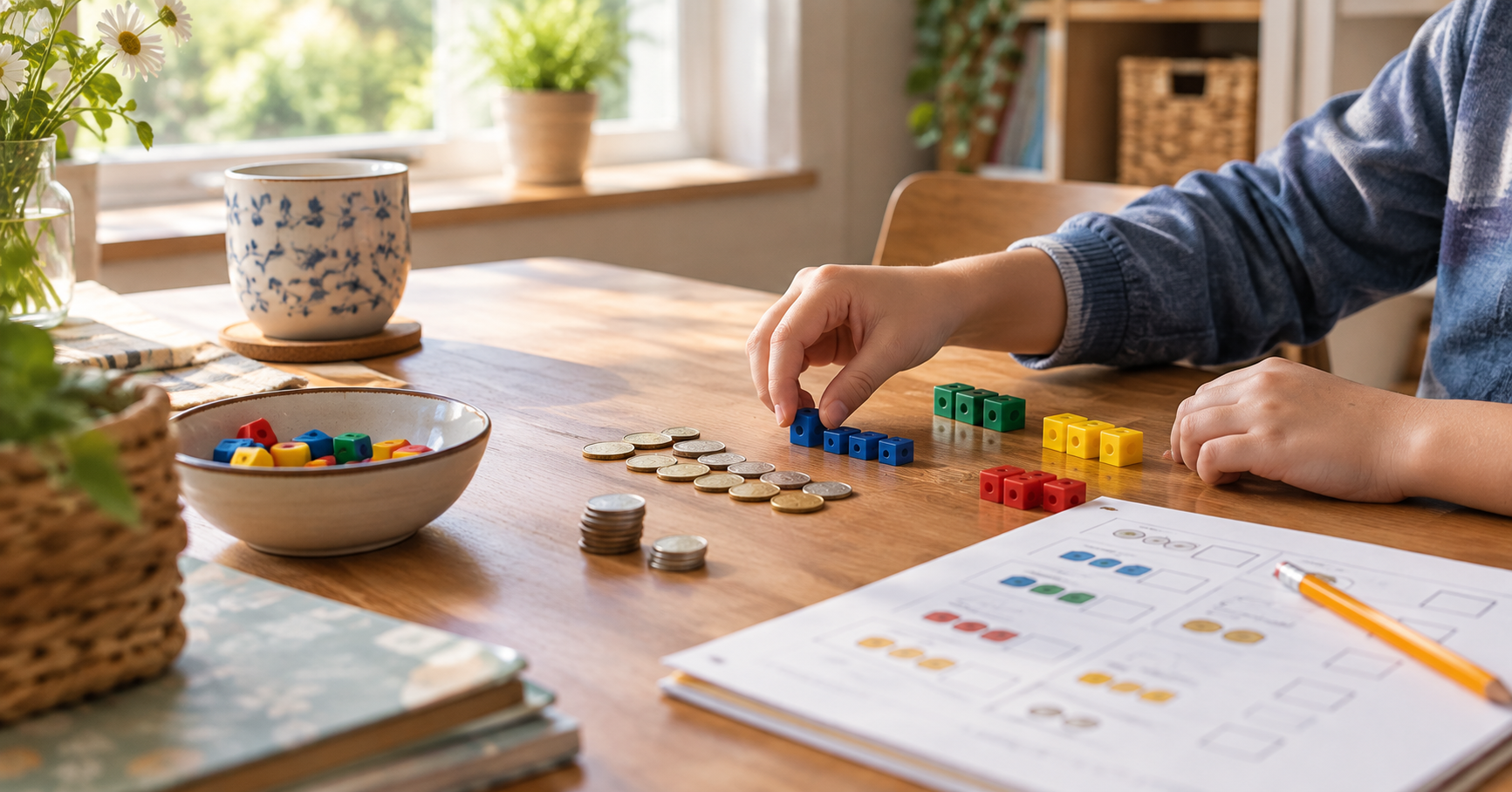
If you're setting up a 1st grade math homeschool this year, the math itself is the easy part: counting, simple addition and subtraction, shapes, and a bit of measurement and money. What actually trips parents up is the routine — how much to cover each day, how a lesson should go, and what to do when something doesn't click. Here's how I think about it, the same way I teach math in our own house.
What a 1st grader works on in math over the year
Most 1st grade math programs move through a similar arc, usually in this order:
- Numbers and counting — counting forward (and eventually backward) past 100, understanding place value in a loose way, and making sense of zero.
- Addition and subtraction — starting with counting on from the larger number, then building speed with doubles facts (1+1 up to 6+6) and near doubles.
- Shapes and measurement — naming common 2D shapes and measuring length with everyday objects before moving to standard units like inches.
- Data and money — sorting and counting objects, reading simple graphs, and recognizing coins and price tags.
- Problem solving — short math puzzles, missing-number sentences, and small hands-on projects like a class survey.
In HSEA's own 1st grade math lessons, this is roughly the order: Numbers and Counting, then Addition and Subtraction, then Shapes and Measurement, then Data and Money, then a final stretch of problem-solving and projects. You don't need our program to follow that order — it's just a sensible sequence for this age, and most curriculums land somewhere close to it.
How to teach 1st grade math at home, one lesson at a time
At six and seven, kids learn best with your full attention, not with long hours. Here's how a lesson goes in our house.
- Have the lesson printed before you call your child. It matters, for them and for you: you start calm, without hunting for paper.
- Read it together, then talk. I read the lesson once, slowly, and let my kids try to read the vocabulary themselves. Then I add my own explanations and examples from daily life. Questions come up, we talk, and this is the best moment of the lesson: it's where the real learning happens, and kids love having your full attention.
- Paper exercises, with you nearby. Read the instructions with them if needed, show one example, then let them try. If they're stuck, they go back to the lesson themselves. That's how they learn to look for the answer.
- Correct together, then a mark and an encouraging comment. Explain mistakes without giving the answer, so they get a second chance. Then check they've really understood, and give a mark with an encouraging word. I hesitated about marks at first, but my kids love them.
The whole lesson takes about 45 minutes. The next day, a short 10-minute review of the same lesson locks in what they learned. Start with one lesson a day in the first week. After that, up to two a day works well. More becomes overwhelming, for kids and parents.
Don't try to copy a school day. A school day is long, but much of it is transitions and managing a whole class. At home, with one or two children at the table, 45 focused minutes goes a long way.
If you're also setting up the rest of your homeschool routine around this, our calm first-month plan for starting homeschooling covers how to build a daily schedule without overwhelming yourself or your child.
Common sticking points and how to help
A few places where 1st graders predictably get stuck, and what tends to help:
- Zero feels confusing. Kids who count fluently can still struggle with the idea that zero means "none." Concrete objects help more than worksheets here — take away the last block and ask what's left.
- Addition facts feel slow. Counting on from the larger number (not starting over from one every time) is the skill that speeds things up. A lesson like Adding Small Numbers is built around exactly that habit.
- Doubles facts don't stick. Facts like 3+3 or 5+5 are worth memorizing early because so many other facts build on them. We walk through this directly in Doubles and Near Doubles.
- Measurement feels abstract. Starting with nonstandard units — paper clips, cubes, a child's own hand — before introducing inches or centimeters makes the idea of "measuring" click faster.
- Word problems feel harder than the math underneath them. Reading the problem out loud together and asking "what do we already know?" before reaching for numbers usually unsticks this.
None of these are signs that anything is wrong — they're just the normal bumps of this age. Slowing down for a day or two on one idea is almost always better than pushing forward and hoping it resolves itself.
Choosing a 1st grade math curriculum
If you're comparing options, a few fair questions to ask of any curriculum:
- Does it explain the "why," not just give answer keys?
- Can you see what your child is actually practicing, on paper, not just on a screen?
- Is the daily time commitment realistic for a six- or seven-year-old, and for you?
- Can you adjust the pace up or down without losing your place?
HSEA is one option worth knowing about: it's a paper-first curriculum for grades 1-6. You read the lesson together, your child does the thinking on paper, you correct together, and a short screen review the next day reinforces it. It's skills-based rather than tied to any particular state or national standard, so it's worth checking what your own homeschool reporting requires where you live before relying on any single curriculum for that purpose. Lesson 1 of Counting to 100 is free to try if you want to see what a lesson actually looks like before deciding anything.
Whatever you choose, the real engine of 1st grade math homeschool is consistency: a lesson most days, read together and talked through, a short review the next day, and patience on the days a concept takes longer than expected.
Frequently asked questions
How long should a 1st grade math lesson take at home?
About 45 minutes at the table: reading the lesson together and talking about it, the written exercises, then correcting together. Add a 10-minute review of the same lesson the next day. Don't try to copy a school day. A school day is long, but much of it is transitions and managing a whole class. At home, 45 focused minutes goes a long way.
How many math lessons should a 1st grader do per day?
One lesson a day in the first week, while you both settle into a routine. After that, up to two lessons a day works well. Beyond that, it becomes overwhelming and less productive.
Does 1st grade math homeschool need to follow state standards?
Not necessarily, but homeschool reporting requirements vary by location, so check the rules where you live if you need your curriculum to meet a specific legal requirement. Many homeschool math curriculums, including skills-based ones, are not formally aligned to a state or national standard.
What if my child isn't getting a math concept?
Slow down rather than push forward. Go back to the lesson together, talk it through again, and spend an extra day on the same idea with concrete objects (blocks, coins, paper clips) before moving on. A few extra days on one concept rarely causes a real delay.
Unlock the full HSEA system for 7 days.
Add your first kid profile and your 7 days start: every lesson in every grade, saved progress for each child. Nothing to set up, no card required, nothing to cancel.
- ✓ All 1,680 lessons, Grades 1–6, every subject
- ✓ Profiles + saved progress for every kid
- ✓ Printable lessons with answer key