
A Realistic Homeschool Schedule for Elementary Grades
A workable homeschool schedule for elementary grades is not about filling every hour of the day. It is one or two focused lessons, built around a routine your child can predict before you ever look at a clock. Here is how to plan a homeschool day that still holds up past the first week, a sample schedule you can borrow, and what to do on the days it falls apart anyway.
How to plan a homeschool day for elementary kids
Before you write out times, get the shape of the day right.
Start smaller than you think you need. In the first week, one lesson a day is enough while everyone - including you - finds a rhythm. After that, at most two lessons a day works well for elementary grades. More becomes overwhelming and less productive, even on a day when your child seems to have the energy for it.
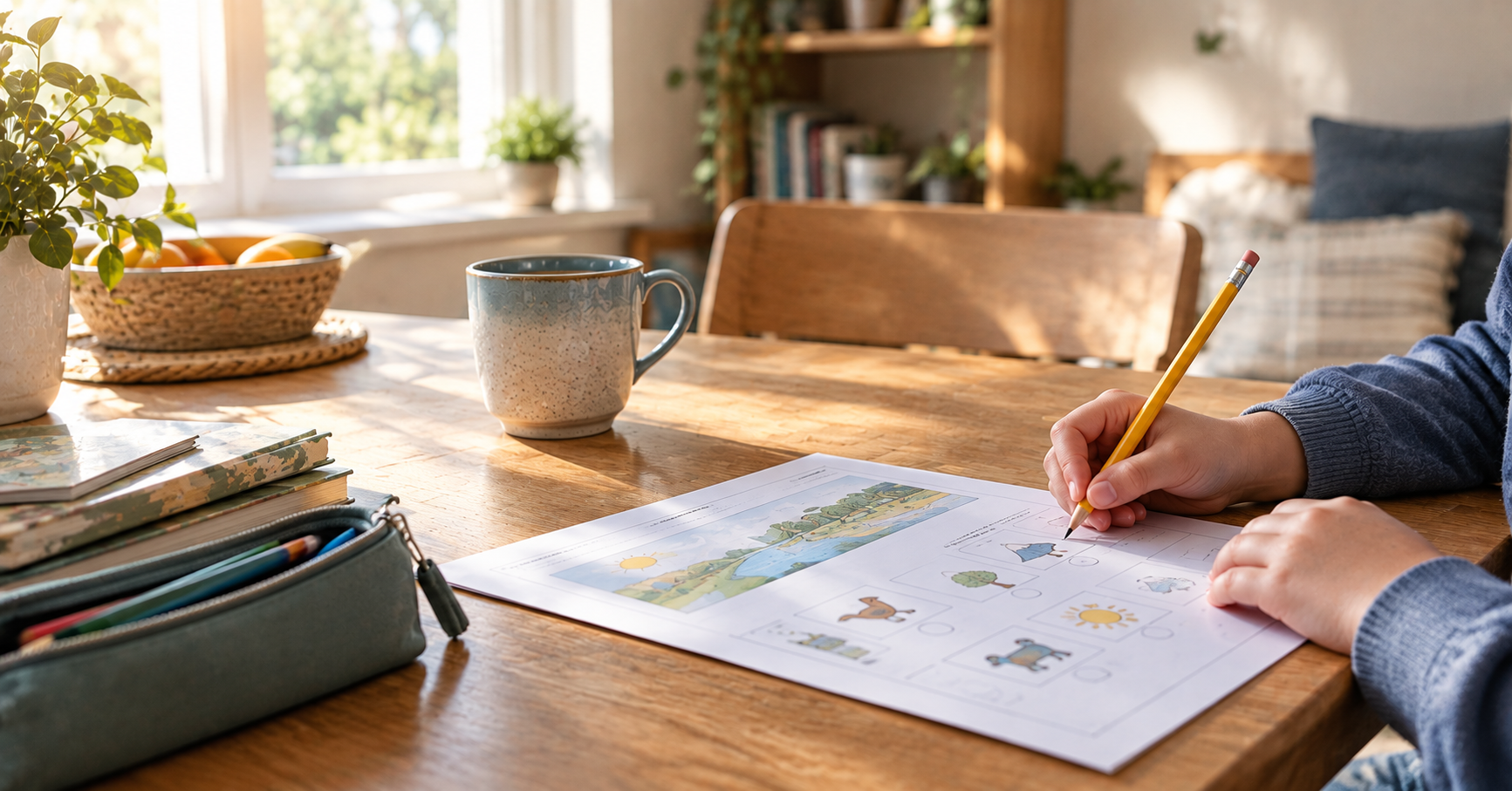
Have the lesson ready before you call your child to the table. Printing it ahead of time, with pencils out, matters more than it sounds like it should. It signals that this is a real sit-down, not something you are scrambling to assemble while your child waits.
Protect the talking part of the lesson. Read the lesson once, slowly, and let your child try the vocabulary themselves before you jump in. This is where questions come up and the real learning happens - it is the best moment of the lesson, not a box to check before "the real work" of the exercises.
Keep the order predictable, not the clock. Doing subjects in roughly the same sequence each day gives the day a shape without forcing a rigid start-and-stop time. Some discussions run long. That is fine; it usually means the lesson is working.
If you are still setting up your routine from scratch, how to start homeschooling walks through a calmer first month before you try to lock in a daily schedule.
A sample homeschool schedule for elementary grades
Here is what a loose daily schedule can look like once the rhythm is set, built around a single lesson of about 45 minutes at the table, plus a 10-minute screen review the next day of that same lesson.
A sample day
- Morning, first lesson (about 45 minutes): Read the lesson together once, talk through the vocabulary and whatever questions come up, then do the exercises on paper, then correct together and give a mark and an encouraging comment.
- Break: Outside, a snack, something that is not school.
- Second lesson, most days (about 45 minutes): Same structure, a different subject.
- Screen review (10 minutes): Your child redoes yesterday's lesson on screen. This is the only point in the day the screen gets used - as a review of what was already taught at the table, never as the teaching itself.
- Rest of the day: Free reading, projects, chores, outside time - whatever your family already does.
Across a week, rotate through subjects so none of them piles up. See what each grade level covers if you want to map out which subjects to work through and when.
Homeschool daily schedule when you have more than one child
A schedule for one child does not simply multiply when you add a second or third. The parent time does not scale that way either, as long as the children are staggered at the same table instead of taught back to back in full.
Everything gets printed before anyone sits down. One child reads and talks through the lesson with you while the others work through their own exercises. Then you correct with each child in turn, ticking off what they really understood. A child who finishes moves on to the screen review of yesterday's lesson while you turn to the next one. For three children doing one lesson each, that adds up to about an hour and a half of parent time, staggered rather than stacked - not three separate 45-minute sessions back to back.
How to homeschool several kids at once goes through this staggered-table approach in more detail if you are juggling more than one grade.
What to do when the schedule falls apart
Some days nothing goes to plan - a sick child, an appointment, a morning that just unravels. A few things help:
- Drop to one lesson instead of two. One finished lesson, done properly, beats two rushed ones.
- Do not try to "catch up" by doubling up later. Two lessons a day is already the ceiling for elementary grades. Stacking three or four onto a single day to make up for a missed one tends to backfire.
- Expect the first couple of weeks to be messier than the rest. A schedule is something you grow into, not something you get right on day one.
A homeschool schedule for elementary grades works best when it is built around how your child actually learns at this age - one focused lesson at a time, with real breaks - rather than around how many hours you feel you should be "doing school." Get that part right, and the rest of the timetable tends to sort itself out.
Frequently asked questions
How long should a homeschool lesson be for elementary grades?
About 45 minutes at the table for the lesson itself, plus a 10-minute screen review of that same lesson the next day.
How many lessons a day should an elementary homeschooler do?
Start with one lesson a day in the first week while you find a rhythm. After that, at most two lessons a day works well - more tends to become overwhelming and less productive.
What if our homeschool schedule keeps falling apart?
Drop to one lesson instead of two rather than skipping entirely, and resist the urge to double up the next day to catch up. Protect the discussion part of the lesson even on difficult days.
Can one schedule work for more than one child?
Yes, if the children are staggered at the same table rather than taught back to back. One reads and talks with you while the others do exercises, then you correct with each in turn - about an hour and a half of parent time for three children doing one lesson each.
Unlock the full HSEA system for 7 days.
Add your first kid profile and your 7 days start: every lesson in every grade, saved progress for each child. Nothing to set up, no card required, nothing to cancel.
- ✓ All 1,680 lessons, Grades 1–6, every subject
- ✓ Profiles + saved progress for every kid
- ✓ Printable lessons with answer key