
1st Grade Science Homeschool: Topics, Activities, and Tips
What Do 1st Graders Learn in Science at Home?
A 1st grade science homeschool year does not need a lab, a microscope, or a stack of equipment. At six and seven years old, children learn science mostly by noticing and naming the world in front of them: is this alive, what is the sky doing today, what is this object made of, and is it safe to use on my own? A full year of 1st grade science topics is usually built around five areas: living and nonliving things, the Earth's land, air, and water, everyday materials, the human body, and simple science projects that pull the earlier units together.
The rest of this article walks through each unit, then gives you activities you can run with things you already have at home.
1st Grade Science Topics, Unit by Unit
In HSEA's Grade 1 science curriculum, the forty lessons are organized into five units:
- Living and Nonliving (lessons 1-8) starts with the basic question every science year should start with: how do you tell a living thing from a nonliving one? That question is the subject of the first lesson, What Is Living?, which you can open and try for free. The unit continues into habitats, including Animals and Their Homes, where children learn what a habitat is and why an animal's home matters to it.
- The Earth and Sky (lessons 9-16) names the three main parts of the Earth - land, air, and water - and moves into weather, including Clouds and Rain, where children learn to name and describe cumulus, stratus, and cirrus clouds and talk about how clouds form.
- Materials and Matter (lessons 17-24) looks at everyday objects and their uses, then at which materials are safe to use and which ones need a grown-up.
- Our Body and Health (lessons 25-32) covers the main parts of the human body and why exercise and movement matter.
- Science Projects (lessons 33-40) puts it all into practice, including a plant observation journal and a Simple Experiment Fair, where children design and carry out a simple experiment using the five steps of the scientific method: question, prediction, method, results, conclusion.
You can see the full subject plan on the Grade 1 Science page.
1st Grade Science Activities at Home With Things You Already Have
You don't need to buy a kit for most of this. A handful of 1st grade science activities at home use what's already in the kitchen drawer or the backyard:
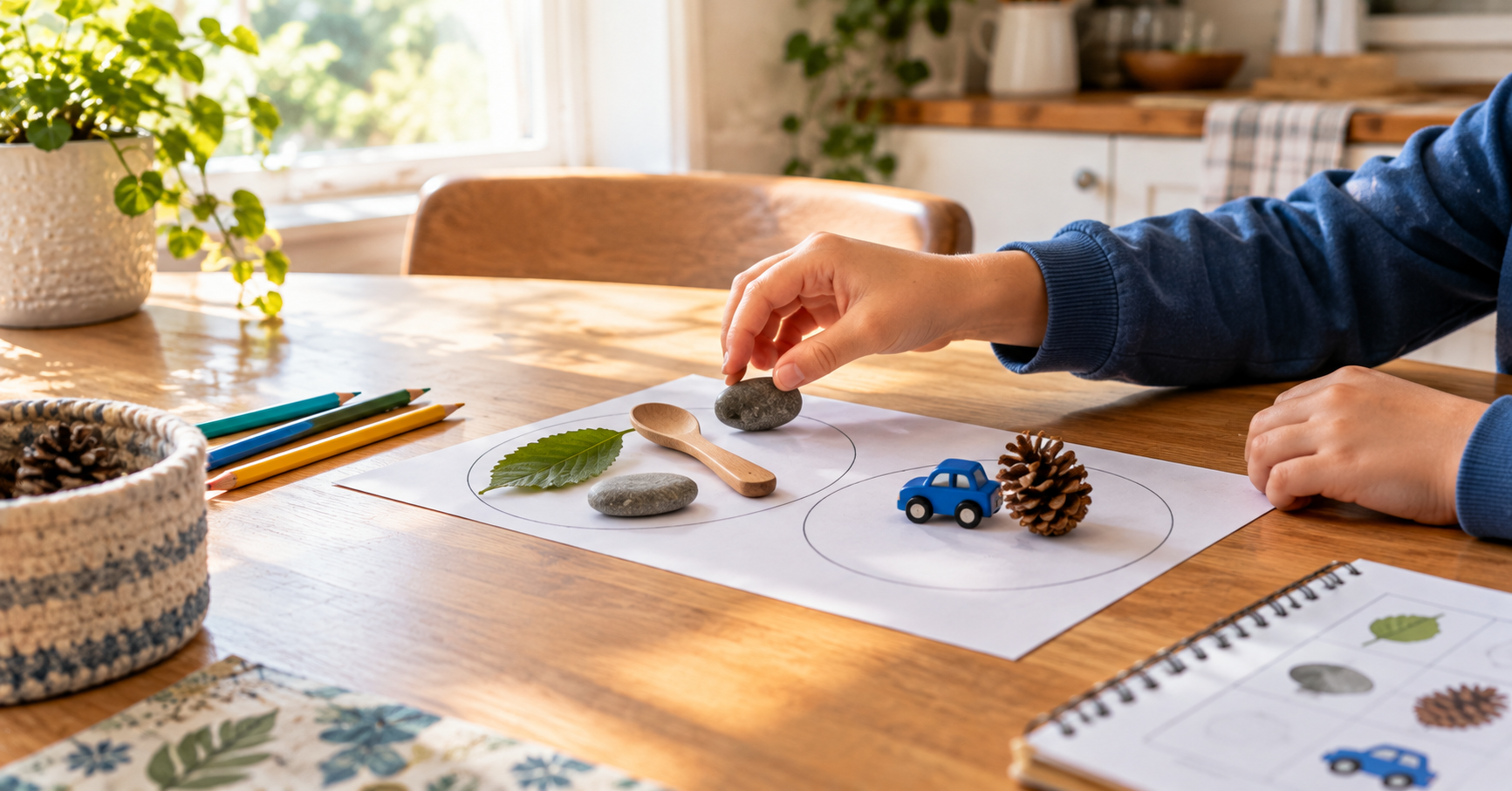
- Living or nonliving sort. Collect ten small objects from around the house or yard - a rock, a leaf, a spoon, a toy, a houseplant leaf, a bug if you find one outside. Sort them into two piles and talk through why each one belongs there.
- Sky watch. Step outside, look up, and sketch what the clouds look like. Compare the shapes to what the lesson calls cumulus, stratus, and cirrus clouds.
- Material sort. Open a kitchen drawer and sort objects by what they're made of - wood, metal, plastic, fabric. Then talk about which ones your child can use on their own and which ones, like a knife or the oven, are only used with you.
- Body map. Stand in front of a mirror and name the main parts of the body together, then move around together and talk about why exercise matters.
- Plant journal. Plant a bean in a cup on the windowsill and sketch it every few days in a notebook, noting what changed.
None of these need to be fancy. The point is for your child to look closely and put the lesson's vocabulary to use in something real.
Keeping Curiosity High During Each Lesson
The part of a science lesson that actually builds curiosity isn't the worksheet - it's the conversation. Have the lesson printed and ready before you call your child over. Read the lesson once, slowly, while your child listens, and let them try to read the vocabulary themselves. This is the moment to add your own explanations, and it's usually where the questions start - that back-and-forth is the best part of the lesson, not a distraction from it.
After that, your child works through the exercises on paper, rereading the lesson on their own when they need to find an answer. Then you correct together: explain mistakes without giving away the answer, so they get a second chance, and finish with a grade and an encouraging comment. All of that takes about 45 minutes at the table. The next day, your child redoes the same lesson on screen for about 10 minutes, which locks in what they learned. One lesson a day is plenty in the first week; after that, up to two a day works, but more tends to overwhelm rather than help.
This is the approach HSEA is built around for grades 1 through 6: paper-first lessons you teach at the table, with a 10-minute screen review the next day, not a program your child works through alone on a screen. The Parent Guide walks through exactly how a lesson like this runs, start to finish.
A Simple Weekly Rhythm for 1st Grade Science Homeschool
Science doesn't need daily time the way reading or math often does. Many families fit one or two science lessons into the week alongside their other subjects. At one a week, the forty lessons cover a full school year; at two a week, about half of one. If you're still figuring out how science fits around everything else, a realistic elementary homeschool schedule can help you block out the week, and if you're mapping out the rest of 1st grade, our guide to 1st grade math homeschool covers the same at-the-table approach for that subject.
Wherever you land on timing, the goal for 1st grade science is the same: let your child notice, ask, and talk about the world around them, with you right there to answer and explain.
Frequently asked questions
Do I need special equipment for 1st grade science at home?
No. Most 1st grade science topics - living and nonliving things, weather, materials, and the body - can be explored with things you already have: a kitchen drawer, a backyard, a mirror, and a notebook for sketches. You only need a printer, paper, something to write with, and some time outside or in the kitchen.
How long should a 1st grade science lesson take?
About 45 minutes at the table to read the lesson together, talk about it, and work through the exercises, plus a 10-minute screen review of the same lesson the next day. One focused lesson a day is enough in the first week, and up to two a day after that.
What if my 1st grader isn't that interested in science yet?
Curiosity usually grows from conversation, not from the topic itself. Reading the lesson together and letting your child ask questions as they come up tends to do more than the worksheet.
Does 1st grade science need to follow a specific state standard?
Requirements vary by state and country, so check the homeschool rules where you live. HSEA's 1st grade science lessons are skills-based and not aligned to any particular state or national standard.
Unlock the full HSEA system for 7 days.
Add your first kid profile and your 7 days start: every lesson in every grade, saved progress for each child. Nothing to set up, no card required, nothing to cancel.
- ✓ All 1,680 lessons, Grades 1–6, every subject
- ✓ Profiles + saved progress for every kid
- ✓ Printable lessons with answer key