
What to Look for in a Printable Homeschool Curriculum
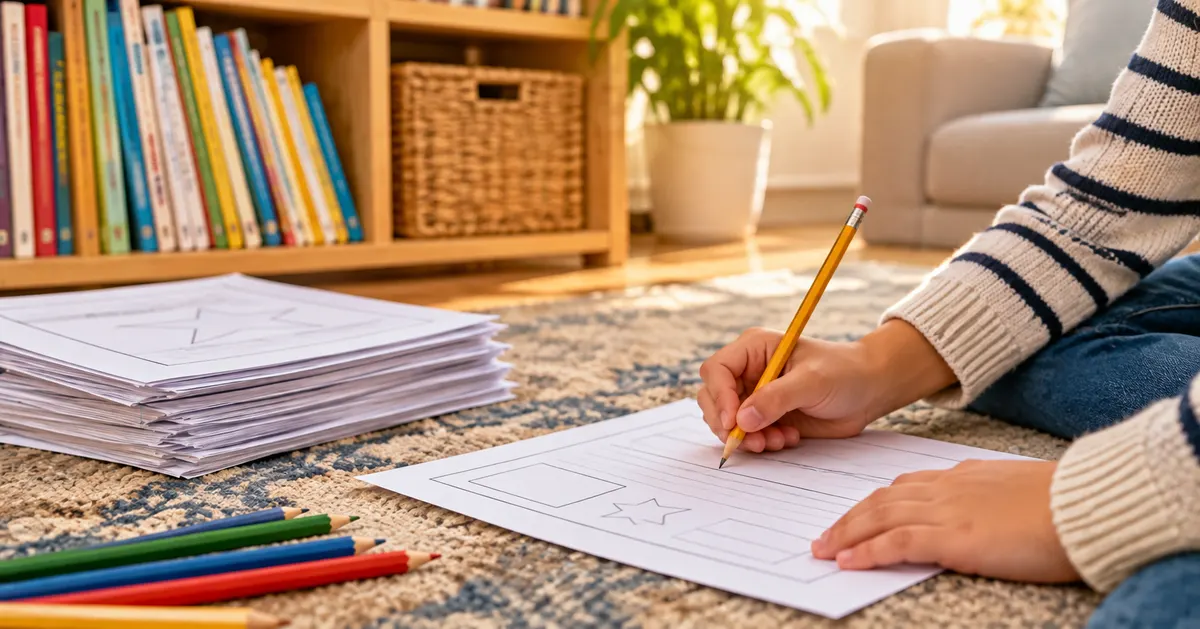
A printable homeschool curriculum gives you lessons you print at home and teach from the page, instead of lessons that live only inside an app. For many families with young learners, that format works better: fewer screens, more time at the table, and a parent who can see exactly what their child is learning, lesson by lesson. If you are weighing printed lessons against an all-screen program, here is what actually matters, and how to make printed lessons work well in your week.
Why Printed Lessons Work Well for Young Learners
A printed page asks a child to slow down. They write by hand, follow along as a parent reads, and are not pulled toward anything else on a device. For the parent, it means being fully present rather than supervising from a distance. Having the lesson printed and ready before you call your child over changes how they show up to it.
What to Look for in a Printable Homeschool Curriculum
Not every printable workbook is built the same way. A few things are worth checking before you commit to one:
- Clear objectives. Each lesson should say plainly what your child is meant to learn, not just hand over a worksheet.
- A short explanation before the practice. A real curriculum teaches something first, usually with a vocabulary box your child can read and come back to, then asks for practice.
- Exercises on paper, not just a worksheet. Look for guided practice first, then applied exercises, so your child tries the skill with support before trying it alone.
- An answer key for the parent. You should not have to guess whether an answer is right. A good printed lesson includes the key, usually at the end.
- A simple way to record what your child understood. A parent checklist you tick after correcting is enough; you do not need anything more complicated to know what was learned.
- Lessons organized by grade and subject, so you can see what is coming next instead of guessing. You can browse what each grade covers across subjects on the grade pages before you choose a curriculum.
- Honesty about its limits. A skills-based curriculum is not automatically aligned to your state's standards, and it is worth knowing that up front rather than assuming it.
How to Organize Printed Lessons at Home
Printing everything for a full unit at once usually backfires: pages pile up, and it is easy to lose track of which ones were already covered. Print just one or two lessons ahead at a time instead, and keep the answer key with the lesson rather than in a separate pile, so you can correct right away.
A simple folder or binder per subject, or per child if you are teaching more than one, keeps things easy to find. With several children, lessons are staggered at one table rather than taught all at once: one child goes through their lesson with you while the others work on their exercises, and you correct with each child in turn. For a fuller walkthrough of that routine, see how to homeschool several kids at once. For keeping completed pages and records sorted over the year, our guide on homeschool record keeping covers simple systems that hold up over time.
Print and Teach: A Simple Daily Routine
The routine around a printed lesson matters as much as the pages themselves. Here is the shape of the HSEA method: the lesson is printed and ready before you call your child over. You read it once, slowly, while they listen and try the vocabulary themselves. Then you talk about it together. Questions come up, you go off on a tangent, and that discussion is where most of the real learning happens, often more than in the exercises that follow. Next come the exercises on paper; if your child gets stuck, they reread the lesson on their own first, which teaches them to search for the answer rather than ask right away.
When the exercises are done, you correct together. Explaining a mistake without just giving away the right answer gives your child a second chance to get there themselves. Then comes a mark and an encouraging comment, which many children quickly start to look forward to. All of that takes about 45 minutes at the table. The next day, the same lesson gets a 10-minute review on screen, just to lock in what was already taught on paper. One lesson a day is plenty to start, and up to two a day is the most that stays productive; beyond that, it gets rushed and the discussion loses its value.
Keeping Track of Worksheets and Progress
Printed lessons do not have to mean paper piles with no record of progress. A parent dashboard that shows progress by grade and subject, and what comes next, is worth having even with a print-first curriculum. In HSEA, every child has their own profile, and a Skills mastered PDF on the dashboard lists each skill a child has completed at 90% or more, grouped by grade and subject, which is handy to keep for a homeschool portfolio alongside the printed pages themselves.
Whichever curriculum you choose, the page is only half of it. The routine you build around reading together, talking it through, and correcting as a team is what actually makes printed lessons work.
Frequently asked questions
Is a printable homeschool curriculum better than a screen-only program?
Both can work. Printed lessons keep your child reading and writing on paper and give the parent a clear page to teach from. Many families prefer a paper-first approach for young learners, then add a short screen review only to reinforce what was already taught on paper.
How many printable lessons should we do in a day?
Most children do well with one lesson a day, especially at the start. Up to two lessons a day works for many families; beyond that, lessons tend to feel rushed and the discussion that follows each one loses its value.
Do printable curriculums still use a screen at all?
Some do, as a short review rather than the main teaching. In HSEA, for example, the lesson itself happens on paper at the table, and the child reviews the same lesson on screen for about 10 minutes the next day.
How do I keep printed worksheets organized?
A simple system works best: a folder or binder per subject, lessons printed a few at a time instead of a whole unit at once, and answer keys kept with the lesson so you can correct right away. See our homeschool record keeping guide for a fuller system.