
Homeschool Record Keeping: What to Keep and Simple Systems That Work
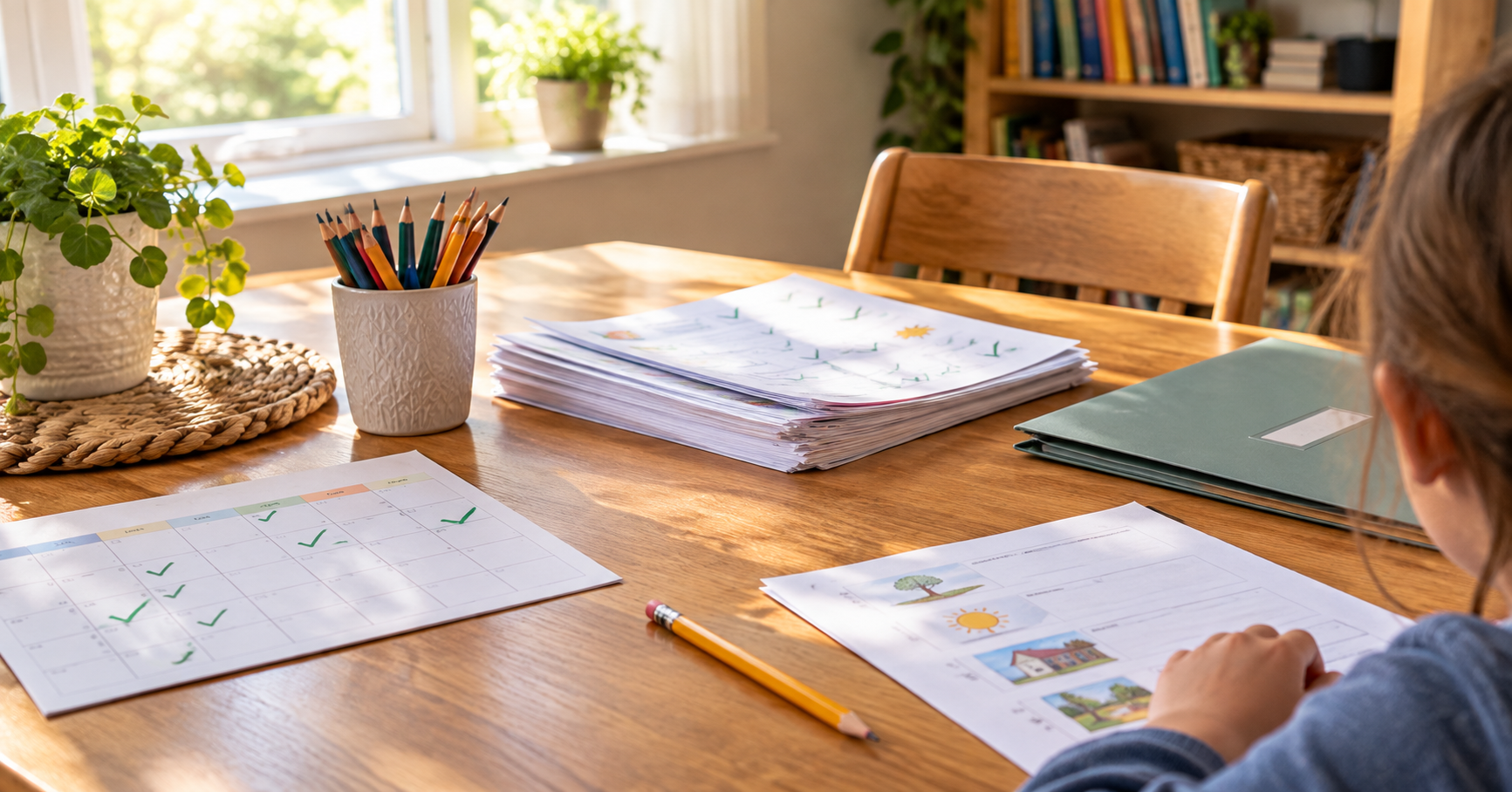
Homeschool record keeping is simply the habit of writing down what your child studied, how it went, and how often you sat down together to learn. It does not have to be complicated, and it does not need to take over your week. A short weekly habit, kept consistently, will tell you everything you need to know months or years later.
Homeschool record keeping: what to keep
Most homeschool records fall into a short list, and you do not need all of them to have something useful:
- An attendance log — the dates you studied, even in a simple grid or calendar.
- A curriculum or subject list — the units, topics, or lessons covered in math, reading, writing, science, and any other subject.
- Work samples — a handful of pages per subject per term, not every worksheet.
- Grades or assessment notes — how your child did on exercises, projects, or any lesson that was corrected.
- A reading log — titles finished, with the date.
- Certificates or finished projects — anything with a clear end point is worth keeping as-is.
You do not need to invent a system from scratch for any of this. If your curriculum already produces some of it, like corrected exercises or a view of what has been covered, your record keeping is mostly a matter of saving what already exists rather than creating something new.
Tracking homeschool attendance and grades without turning it into a chore
Attendance and grades are the two records parents worry about most, and both are easier than they sound.
For attendance, a monthly calendar with a checkmark on each day you studied is usually enough. You do not need to log hours unless where you live specifically asks for them, and requirements do vary, so check the rules in your state or country before deciding how much detail to track.
For grades, the easiest approach is to record them at the moment they happen, not later from memory. In my own homeschool, that happens as part of the lesson itself: after my kids finish their exercises, we correct the work together, I explain any mistakes without giving away the answer so they get a real second try, and then I give a mark and an encouraging comment. That mark already exists by the time the lesson is done, so writing it into a record takes a few seconds, not a separate sit-down session. In HSEA, each lesson has a parent checklist where you tick what your child understood and what still needs work, so the record is a byproduct of teaching rather than an extra task.
A simple weekly system that takes minutes, not hours
Pick one place to keep records and stay with it. A spreadsheet, a notes app, or a paper binder divided by month all work equally well. What matters more than the tool is the habit:
- Once a week, usually on the same day, write down the dates studied, the subjects and units covered, and any grades or marks from that week.
- Keep one folder or envelope per month for work samples, and drop in a page or two per subject as you go, rather than sorting at the end of the year.
- File certificates, finished projects, and reading logs as they happen, so nothing gets lost waiting for a bigger cleanup.
Ten minutes on a Sunday evening, or right after the last lesson of the week, is usually enough to keep everything current.
Why these records are worth keeping
Even where keeping records is not required, most parents find them useful for a few reasons:
- They make it easy to see real progress over a year, which is hard to judge day to day.
- They help if your child ever moves to a co-op, a new curriculum, or another learning setting, since someone outside your home will have something concrete to look at.
- They are reassuring in the first year of homeschooling, when it can be hard to tell whether enough is actually happening.
If you are only getting your systems in place, our guide on How to Start Homeschooling: A Calm First-Month Plan walks through setting up your first weeks, including your very first records. And once you have a realistic homeschool schedule for elementary grades running, the weekly log becomes almost automatic, since you are already tracking what happens each day.
Turning your records into a simple portfolio
At the end of a term or a year, your attendance log, work samples, grades, and reading log can all go into one folder or binder. That is your portfolio: nothing more than everything you already saved, put in one place.
If you use a curriculum with its own progress tracking, that can do some of this work for you. In HSEA, each child's progress is saved when they do the short screen review of the previous day's lesson, and the parent dashboard shows where each child stands in every subject. From the dashboard you can download a skills PDF listing what your child has mastered, and on annual plans your child receives a certificate for each subject they pass. Both are ready-made pieces of a portfolio without any extra compiling on your part. You can see what each grade covers on the grade overview pages, and our parent guide has more on getting organized around a curriculum in general.
Whatever curriculum or system you use, the records themselves matter more than the format. A folder of real work, kept consistently, will always tell you more than a perfect system you gave up on in October.
Frequently asked questions
Do homeschool parents have to keep records?
Requirements vary by state and country, so check the rules where you live before deciding what to keep. Even where records are not required, most parents keep a simple attendance log and some work samples because they are useful on their own, not just for compliance.
What's the easiest way to track homeschool attendance?
A monthly calendar with a checkmark on the days you studied is usually enough. You only need more detail, like hours per subject, if your local rules specifically ask for it.
How often should I update homeschool records?
Once a week is enough for most families. Write down the week's subjects, units, and any grades right after you finish, and file work samples as you go instead of waiting until the end of the term.
What should go in a homeschool portfolio?
An attendance log, a handful of work samples per subject, grades or marks, a reading log, and any certificates or finished projects. Put them in one folder as you go, so there's nothing to assemble later.
Unlock the full HSEA system for 7 days.
Add your first kid profile and your 7 days start: every lesson in every grade, saved progress for each child. Nothing to set up, no card required, nothing to cancel.
- ✓ All 1,680 lessons, Grades 1–6, every subject
- ✓ Profiles + saved progress for every kid
- ✓ Printable lessons with answer key