
Maps, scales and coordinates
How to use: Download the PDF to print the worksheet. Then use this page to repeat activities and check answers.
Learning Objectives
- 1Identify the main features of a map including compass rose, scale bar, legend, and grid
- 2Use coordinates to locate places on a grid map
- 3Explain what the scale bar tells a map reader
- 4Match common map symbols to the features they represent
Mini Lesson
A map is a flat drawing that represents a part of the Earth's surface from above. To make sense of a map, you need to understand the tools it uses: a compass rose, a scale bar, a legend (also called a key), a grid, and coordinates. Together these features turn a flat picture into a powerful navigation tool.
The Compass Rose
The compass rose is a symbol on a map that shows the four main directions: North (N), South (S), East (E), and West (W). It is usually placed in a corner of the map. When you read a map, always find the compass rose first so you know which way is North.
The Scale Bar
The scale bar is a small ruler on a map that shows you the relationship between distance on the map and real distance on the ground. For example, 1 centimetre on the map might equal 10 kilometres in real life. By measuring the scale bar you can calculate real distances between places.
The Legend (Key)
The legend, sometimes called the key, is a box on the map that explains what each symbol, colour, or line means. Without a legend you cannot know whether a blue line is a river or a road, or whether green shading is a forest or a park. Always check the legend before reading the map.
Coordinates and the Grid
A grid is a set of evenly-spaced lines running across and up a map. The vertical lines are labelled with letters (A, B, C...) and the horizontal lines are labelled with numbers (1, 2, 3...). A coordinate is the combination of a letter and a number that names a specific square on the grid. For example, B3 means the square where column B meets row 3. Always read across first (the letter), then up (the number).
How do you find grid square C2 on a map?
Other Common Map Features
- Contour lines — curved lines that join points of equal height, showing hills and valleys on the land.
- Blue shading — represents water: oceans, seas, lakes, and rivers.
- Green shading — usually represents forests, vegetation, or parks.
- Red lines — often mark main roads, borders, or important routes.
- Grid lines — a regular network of lines that helps you locate any place using coordinates.
Tip: the saying "along the corridor, then up the stairs" helps you remember to read coordinates across first (the letter), then up (the number).
Guided Practice
Exercises
Look at the grid map. Tap each grid square as it is named.
Tap the Grid square A1 (top-left)
0 / 4 found · Look at the dashed boxes — tap the right one.
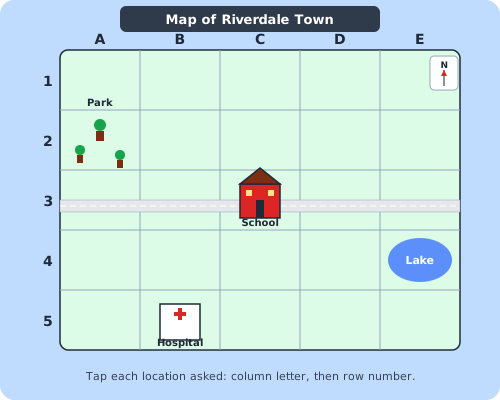
Match each map feature to what it represents.
Pick the best answer for each question.
1. What does the compass rose on a map show?
2. What is the scale bar on a map used for?
3. Which part of a map explains what each symbol or colour means?
4. To find grid square C3, which direction do you read FIRST?
5. What do contour lines on a map show?
6. On most maps, blue shading represents...
7. A grid coordinate like "B3" means...
8. Which tool would you use to find out whether two towns on a map are 50 km apart?
Assessment
Parent / Teacher Checklist