
Maps: Scales and Coordinates
How to use: Print the PDF before you call your child. Read the lesson once together and talk it through, then the exercises on paper. Correct together with the answer key and the Parent checklist. The next day, your child redoes this lesson here on screen (about 10 minutes) to review it and save progress.
Learning Objectives
- 1Use a map scale to estimate real distances between two places
- 2Locate features on a coordinate grid using column letters and row numbers
- 3Identify common map symbols by reading the map key
- 4Describe the difference between large-scale and small-scale maps
Mini Lesson
Maps shrink the real world onto a flat page. Two tools tell you exactly where something is and how big it really is: the map scale tells you how distance on paper compares to distance on Earth, and the coordinate grid lets you name any spot using a letter and a number.
Map Scale
- A scale shows how a small distance on the map matches a much bigger distance in the real world.
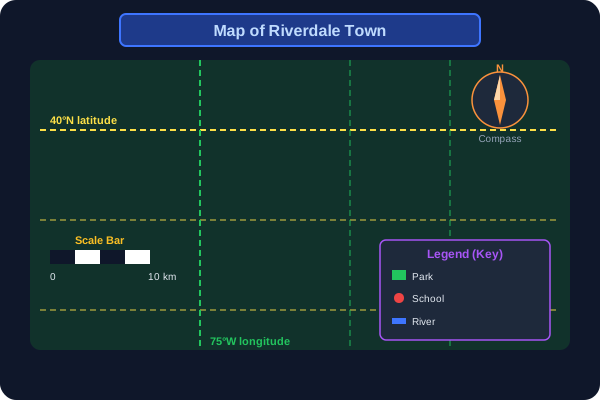
- Bar scales draw a small ruler labeled in kilometers or miles. You measure on the page, then read the matching real distance off the bar.
- Ratio scales look like 1:100,000 — meaning every 1 unit on the map equals 100,000 of the same units in real life.
- Word scales say it plainly: "1 cm equals 5 km" or "1 inch equals 2 miles".
- A large-scale map shows a small area in great detail (one neighborhood). A small-scale map shows a huge area with less detail (a whole continent).
Coordinate Grids
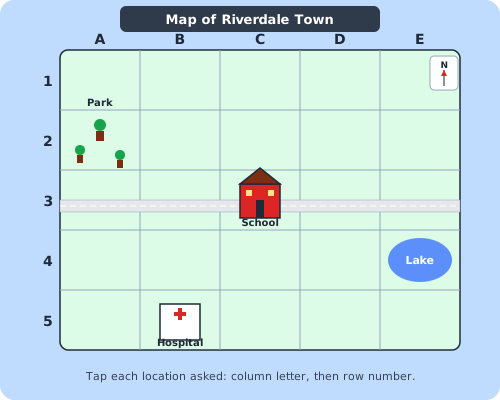
- A coordinate grid is a network of squares laid over a map.
- Columns are labeled with letters (A, B, C, ...) across the top.
- Rows are labeled with numbers (1, 2, 3, ...) down the side.
- A coordinate names the column letter first, then the row number — for example C3 means column C, row 3.
- On a printed road atlas, the index says "Riverdale C3" and the grid square is where you look.
Map Keys and Symbols
- The map key (also called the legend) lists every symbol used on the map and explains what each one means.
- A small triangle often stands for a mountain, wavy lines stand for water, and a tiny tree stands for a forest.
- Different colors can also be symbols — green for parks, blue for rivers and lakes, brown for high land.
- Always read the map key first so you know what every shape and color represents.
Tip: read coordinates as "letter, then number" — column first, then row. C3 is the cell where column C and row 3 cross.
Guided Practice
Exercises
The map shows four labeled places on a coordinate grid. When asked, tap the correct place on the map.
Tap the Park at A2
0 / 4 found · Look at the dashed boxes — tap the right one.
Tap each map element on the diagram as it is described.
Tap the 📏 Scale bar — shows how map distance equals real distance
0 / 6 found · Look at the dashed boxes — tap the right one.
Pick the best answer for each question.
1. A map shows "1 cm equals 5 km". Two towns are 4 cm apart on the map. How far apart are they in real life?
2. On a coordinate grid, what does the coordinate B4 tell you?
3. Which type of map shows the smallest area in the greatest detail?
4. What is the purpose of a map key?
5. A scale of 1:100,000 means that one unit on the map equals how many of the same units in real life?
6. On a town map, the lake is at coordinate E4 and the school is at C3. Which is true?
7. Which scale type uses a small ruler drawn on the map to measure distance?
8. You want a map that shows the entire continent of Africa on one page. Which type of map is best?
Parent Checklist
For the parent: after correcting together, check off what your child has really understood